SC. 05
Live
A contractor that had to win the bid before the first call
A commercial building-envelope contractor whose work arrives as tender packages, and who needed a site that turns an estimator's scope into an enquiry.
- Custom design and build
- Quote-request form
- Credentials and standards content
- Mobile call bar
- The homepage puts the quote-request form in the first screen, beside the headline, rather than on a separate contact page.
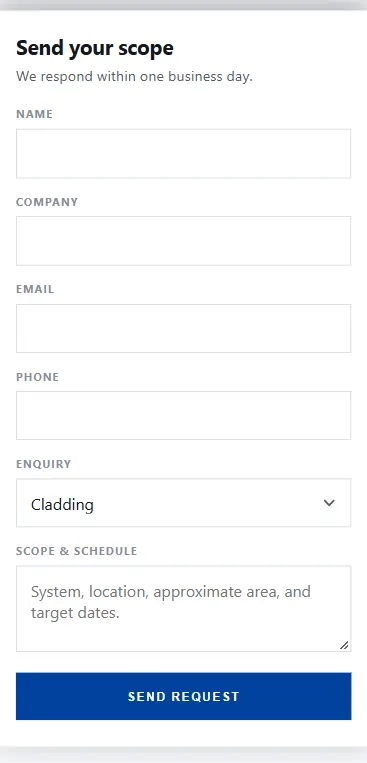
- The form's enquiry field sorts requests by type — including manpower only and requests for references — so the reply can be prepared before anyone calls back.
- Spam is filtered with a hidden honeypot field rather than a captcha, so a real enquiry never has to solve a puzzle.
- On phones, a sticky bar keeps Request a Quote and Call Now on screen for the whole page.
The visitor is an estimator, not a homeowner
Commercial installation work doesn't arrive through browsing. It arrives as a tender package on a general contractor's desk, and the person reading the site is comparing subcontractors against a scope and a schedule. They want three answers quickly: do you install this system, can your crews hold the programme, and how do I get a price.
A site built for a homeowner — a big photo, a slogan, a contact page three clicks away — answers none of them. So the first screen was designed as the answer to all three.
The form asks for a quote, not a conversation
The form sits in the hero, beside the headline. It asks for name, company, email and phone, then what the enquiry is — the panel systems the contractor installs, manpower only, or a request for references — and a single box for scope and schedule, prompted with the four things an estimate actually needs: system, location, approximate area and target dates.
The reply time is promised directly under the heading, so nobody sends a scope wondering if it will be read. When the form sends, the confirmation replaces it in the same space rather than moving the page. Spam is caught by a hidden field that people never see and scripts always fill, instead of a captcha — the one visitor who matters shouldn't be asked to prove they're human.
Credentials before claims
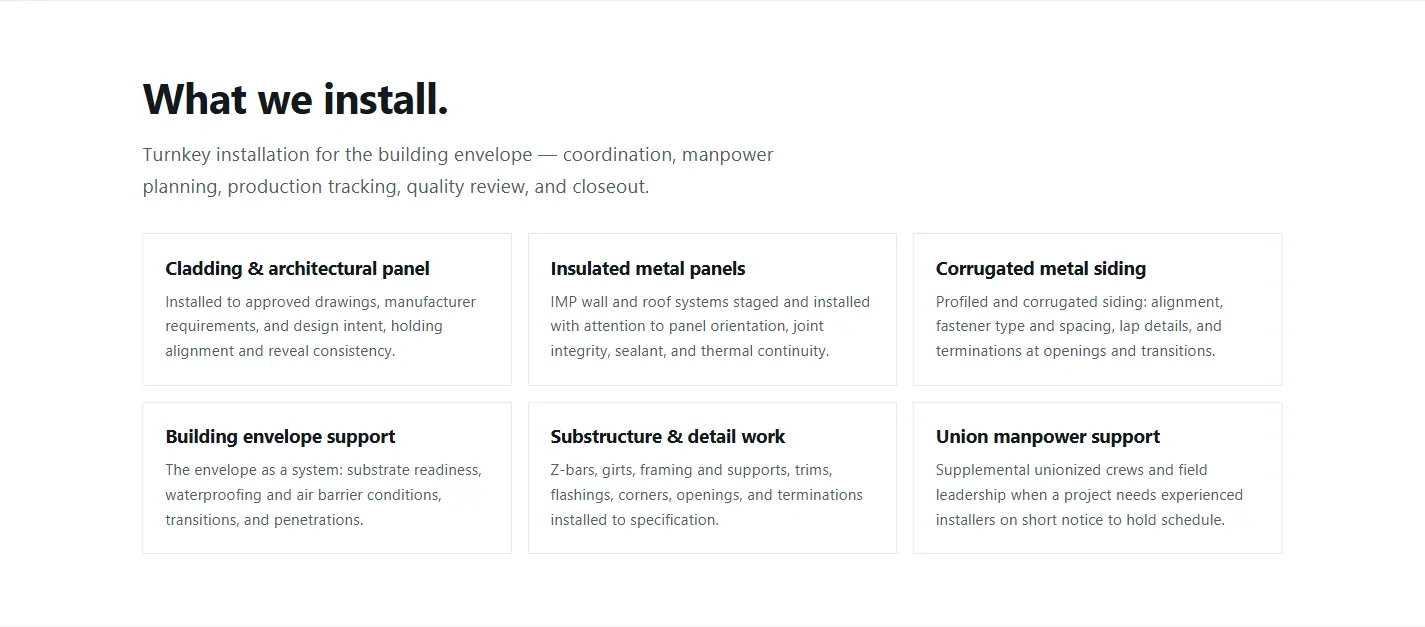
Next to the headline sits a short checklist of the things a general contractor checks before shortlisting anyone. Further down, the installation standard gets its own section, with the documentation it produces and an offer of a sample report — evidence a buyer can hold, rather than an adjective.
Safety gets its own section too. On commercial sites a subcontractor's safety programme is part of how they are vetted, so it is laid out as a numbered process rather than a line in the footer.
Built for the site office and the site itself
Estimators read at a desk; site supervisors read on a phone, outdoors, between other things. On mobile the layout collapses to a single column, and a two-button bar — request a quote, call now — stays pinned to the bottom of the screen the entire way down.
The same page also recruits. A careers section speaks to installers directly, because for a contractor that sells crews, hiring is part of being able to say yes to the next job.
The build
Screens
What it looks like.
Measured
Results
Numbers we can show you.
0
Layout shift
Google's threshold is 0.1. Nothing moves while it loads, form included.
8
Requests to render
The whole homepage, images included, in eight requests.
0
Third-party hosts
Every file comes from the site's own domain. No tag manager, no chat widget, no font service.
Measured 12 September 2026 on the live site from a desktop browser, using the browser's own Navigation Timing, Resource Timing and Layout Instability APIs — figures you can re-take yourself. Load times aren't listed: they were taken from another continent to a server near the client, and a number that mostly measures the distance between the two isn't a fair one. We don't publish conversion or revenue numbers for client work; a number we can't verify isn't proof of anything.
The next one could be yours.
Custom websites in Lebanon typically cost between $1,000 and $2,000, with focused single-page builds from $500. You get a fixed price in US dollars before any work starts.
Also worth reading: web design in Lebanon, everything we do, or pricing and process.