SC. 01
Live
A burger shop that had to look hungry
A halal smashed-burger shop in Beirut that needed to take orders from a phone, at midnight, without a card processor.
- Custom design and build
- Bilingual menu system
- Cart and WhatsApp checkout
- Mobile-first layout
- The site takes orders through WhatsApp rather than a card processor, because card payment approval is slow and often unavailable for small food businesses in Lebanon.
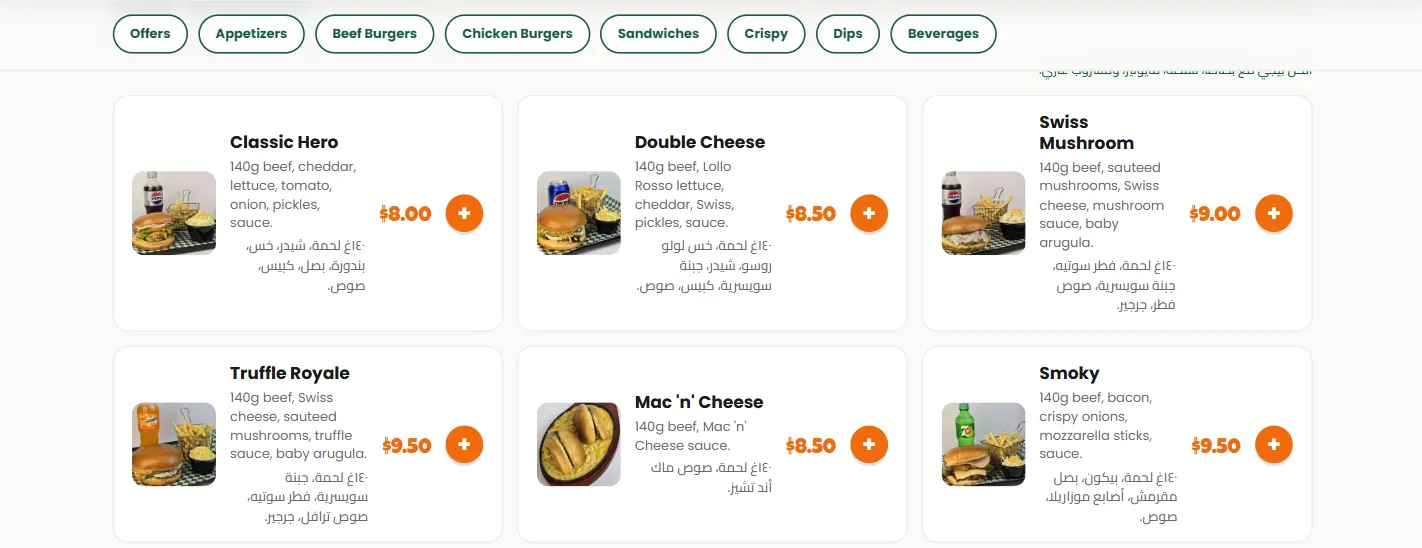
- Every menu item is written in both English and Arabic, in the same card, rather than behind a language switch.
- The menu runs to eight categories and is built as a cart: items are added in place and the order is composed before the customer ever opens WhatsApp.
- The build is mobile-first because the shop trades late — most orders arrive on a phone, one-handed, after dark.
The problem wasn't the website
A burger shop makes its money in a narrow window, late, from people who are already hungry and already on their phone. The decision takes seconds. Anything between wanting the food and ordering the food is a place to lose the sale.
The obvious answer is an online store with a checkout. In Lebanon that is often the wrong answer. Getting a small food business approved for card payments is slow, and for a shop this size it frequently doesn't happen at all. Building a checkout that can't take money is worse than building no checkout.
So the cart ends in WhatsApp
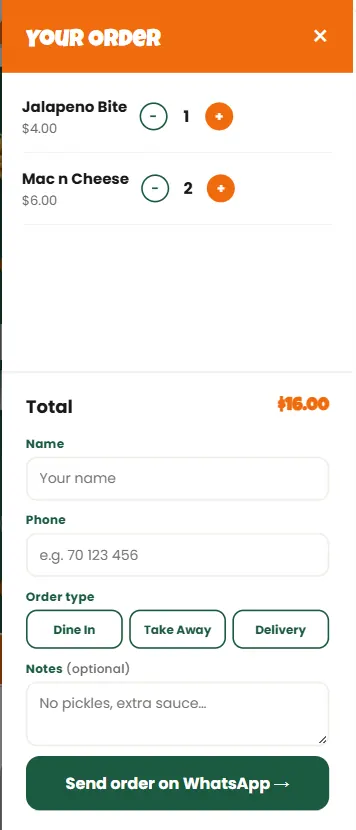
The site has a real cart. Items are added from the menu, quantities adjust in place, and the total updates as you go. What it doesn't have is a payment step. At the end the order, the customer's name and phone, the order type and any notes are composed into a single message and handed to WhatsApp.
This is not a downgrade from a checkout. It's the flow the shop already ran by hand, with the slow part removed. Nobody types out an order any more, nothing gets misheard, and the shop receives a structured message in the app it was already watching. Ordering works the same at midnight as at midday, and it works for a customer who has never installed anything.
Both languages, in the same card
Menu items carry an English name and description with the Arabic directly underneath, in the same card, on the same screen. There is no language toggle to find and no second version of the site to maintain.
This is how people in Beirut actually read a menu. Splitting it in two would have meant a customer scanning for something they recognise having to first make a decision they don't care about.
Built for the phone it's opened on
The layout was designed at phone width first and widened from there, not the reverse. Categories are a sticky row you thumb along. The add control is a single tap, large enough to hit without looking. The cart is a full-height drawer rather than a page you navigate to, so the menu is never lost behind it.
Everything on the page is arranged around one action, which is placing an order. That's the same principle behind every site here — it just happens to be unusually easy to see on a menu.
The build
Screens
What it looks like.
Measured
Results
Numbers we can show you.
3 weeks
Kickoff to launch
Live on 26 July 2026, on the date agreed at kickoff.
0.67s
Time to first paint
Something on screen before most sites have answered.
0.008
Layout shift
Google's threshold is 0.1. Nothing moves while it loads.
14
Requests to render
No plugin layer, no tag manager, no third-party scripts.
Performance measured 2 August 2026 on the live site from a desktop connection, using the browser's own Navigation Timing and Layout Instability APIs — figures you can re-take yourself. We don't publish conversion or revenue numbers for client work. We'd have to take someone's word for them, and a number we can't verify isn't proof of anything.
The next one could be yours.
Custom websites in Lebanon typically cost between $1,000 and $2,000, with focused single-page builds from $500. You get a fixed price in US dollars before any work starts.
Also worth reading: web design in Lebanon, everything we do, or pricing and process.